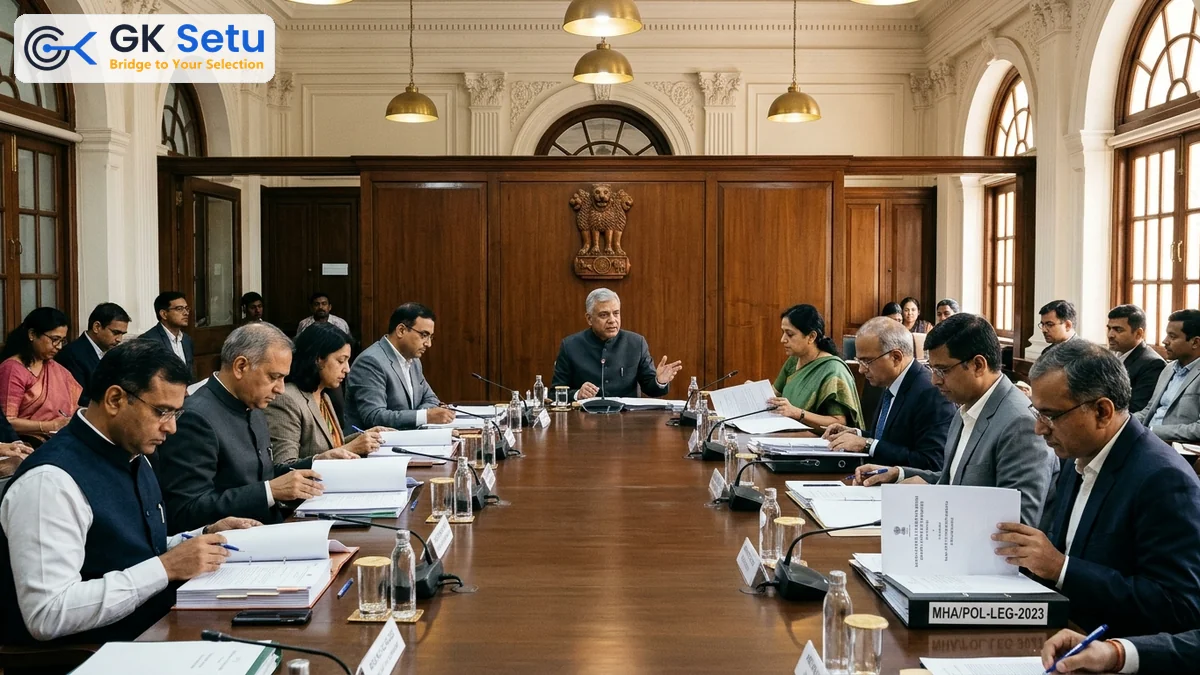
Institutional Reforms: India Standardizes Statutory Oversight Framework
Key Exam Topics & Concepts Covered
- Statutory Bodies: Public entities established by specific Acts of Parliament (such as SEBI or NHRC) equipped with legally binding enforcement powers. Essential for constitutional and governance frameworks in UPSC GS-II and administrative law papers.
- Regulatory Guidelines: Executive and statutory directives issued to enforce operational compliance, financial transparency, and administrative accountability across public sectors.
- Delegated Legislation: The legal process enabling Parliament to confer rulemaking powers upon administrative agencies, maintaining systemic flexibility without requiring frequent legislative amendments.
The "What Happened Yesterday" Catalyst
On October 31, 2026, the Government of India officially notified updated statutory regulations and operational directives governing central autonomous institutions; this action establishes a single compliance architecture across all public regulatory entities.
The Structural Shift
Traffic systems gridlock without clear signals. Public administration follows the exact same mechanical principle. On October 31, 2026, the executive branch recalibrated the administrative master control. By issuing updated operational directives for statutory bodies, the government replaced fragmented oversight protocols with unified digital mandates.
Historically, autonomous entities operated under varying reporting standards; this structural divergence generated procedural friction across inter-ministerial projects. Notably, the new directive eliminates redundant approvals. It enforces strict digital disclosures across all central regulatory institutions.
Sectoral Impact Breakdown
Immediate Institutional Directives
- Standardized Compliance Metrics: All statutory authorities must adopt the unified digital disclosure template within 90 days of notification.
- Simplified Regulatory Limits: Executive boundaries between ministry oversight and internal institutional management are explicitly demarcated to prevent administrative overlap.
- Mandatory Audits: Statutory boards are legally required to submit comprehensive performance metrics to parent ministries every quarter.
Economic & Public Governance Effects
Procedural delays drain capital efficiency. Crucially, streamlining regulatory clearances accelerates institutional approvals for large-scale economic projects; civil applicants gain structured transparency as citizen-facing agencies publish updated operational guidelines within 60 days. In practice, unified digital platforms reduce statutory compliance overhead for public sector enterprises by 15% to 20%.
Long-Term Strategic Impact
Looking ahead, aligning domestic administrative frameworks with international benchmarks elevates India's administrative standing; structural accountability shields public institutions against bureaucratic inertia. Systemic efficiency improves organically. Significantly, this reform creates the foundation for full digital interoperability across public governance platforms by 2030.
Essential Vocabulary & Legal Concepts
- Quasi-Judicial Function
- The statutory authority granted to an administrative agency to conduct formal hearings, resolve disputes, and impose legal penalties akin to a court of law.
- Executive Discretion
- The legal latitude permitted to public officials to act on administrative matters using contextual judgment within established statutory boundaries.
- Institutional Autonomy
- The degree of operational independence granted to a public organization by its founding legislative charter, protecting it from direct political interference.
Implementation Roadmap
| Target Date | Strategic Milestone | Oversight & Review Checkpoint |
|---|---|---|
| Q1 2027 (Jan–Mar) | Phase-1 Alignment | 100% integration of digital statutory disclosure formats across all central bodies. |
| Q3 2027 (Jul–Sep) | Mid-Term Review | Presentation of the inaugural bi-annual institutional compliance report to Parliament. |
| Q4 2028 (Oct–Dec) | Full Interoperability | Complete integration of statutory tracking portals with central administrative systems. |