Article 3 and the Architecture of State Reorganisation
Key Exam Topics & Concepts Covered
- Article 3 of the Indian Constitution: Grants Parliament exclusive authority to form new States, alter state boundaries, or rename existing States by a simple majority. Highly relevant for UPSC GS Paper II and State PSCs.
- Madhya Pradesh Reorganisation Act, 2000: The central enactment that carved out 16 southeastern districts of undivided Madhya Pradesh to form Chhattisgarh as the 26th State of the Union.
- Indestructible Union of Destructible States: A fundamental federal axiom meaning internal administrative units may be altered without state consent, yet the sovereign Union remains unbreakable.
What Happened Yesterday Catalyst
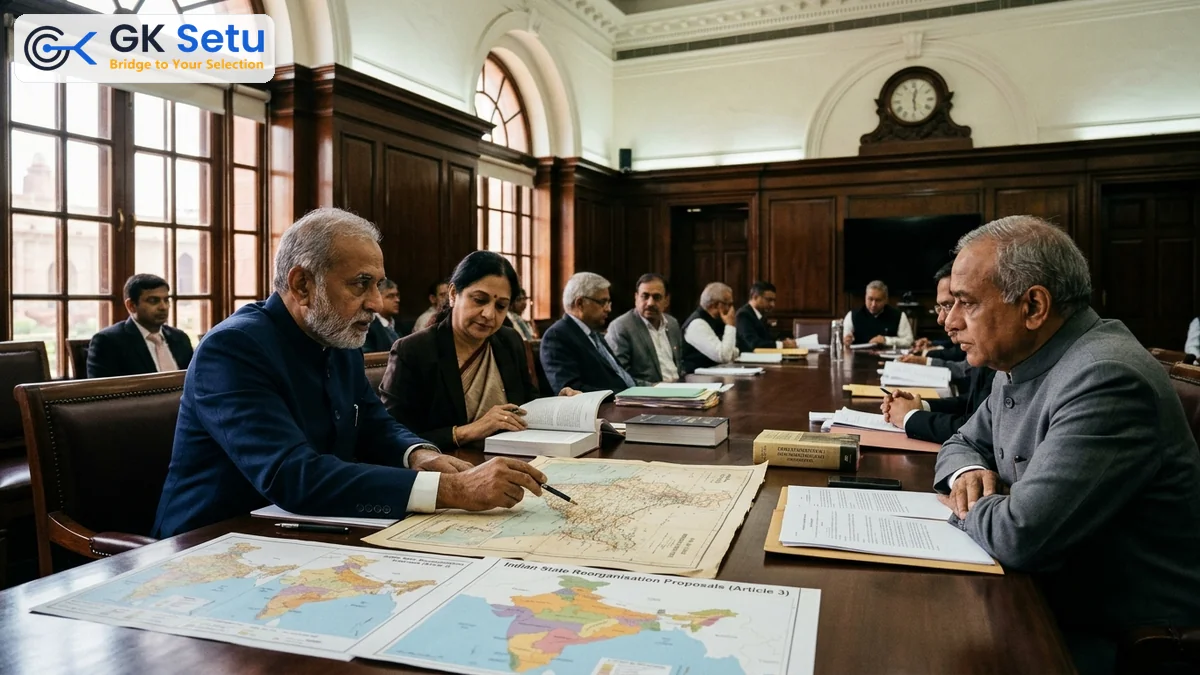
On November 1, 2026, Chhattisgarh observed its 26th State Formation Day, recalling its creation under Article 3 in 2000. Meanwhile, opposition parliamentarians convened a joint assembly in New Delhi to emphasize federal integrity and parliamentary procedures.
Reorganizing a Nation's Map
Governance required endurance. Before November 1, 2000, a resident of Bastar traveled over 700 kilometers to reach the state capital in Bhopal; administrative relief meant traversing dense forests and rugged geography. Decisions lagged. Today, that regional periphery functions as an independent federal state governed directly from Raipur with its own Legislative Assembly and dedicated executive body.
Consider the constitutional framework as a structured dwelling; the founders erected permanent exterior walls to safeguard national sovereignty, while incorporating flexible interior partitions. Under Article 3, Parliament can adjust these internal walls as administrative burdens grow or localized governance demands shift. This legislative mechanism enabled Parliament to detach 16 districts from undivided Madhya Pradesh without altering the structural stability of the Indian Union.
Comparative Breakdown: Pre and Post-2000 Structure
| Parameter | Undivided State (Pre-Nov 1, 2000) | Reorganised State (Post-Nov 1, 2000) | Governance Impact |
|---|---|---|---|
| Federal Identity | 16 southeastern districts within Madhya Pradesh. | Established as the 26th State of India. | Direct constitutional status and targeted development policy. |
| Legislative Authority | Governed exclusively from Bhopal. | Enacted via Madhya Pradesh Reorganisation Act, 2000. | Establishment of a 90-seat state Legislative Assembly. |
| Administrative Proximity | Citizens traveled up to 700 km for grievances. | Central administration operating from Raipur. | Faster executive approvals and localized public services. |
| Fiscal Autonomy | Resources shared across undivided Madhya Pradesh. | Dedicated state budget for local priorities. | Direct oversight of mineral revenues and tribal welfare. |
Stakeholder Impact Analysis
- Citizens and Tribal Communities: Localized decision-making ensures that welfare programs, forest rights, and regional language initiatives align directly with public needs on the ground.
- Parliament of India: In practice, Article 3 illustrates how statutory provisions allow the legislature to reconfigure internal political geography through standard parliamentary voting.
- State Governments and Civil Society: Serves as a working model for federal adaptability. Crucially, political dialogues like the New Delhi mobilization highlight the continuous need to balance state consultation with parliamentary authority.
Key Takeaways and Future Perspective
Flexibility prevents structural fractures. Unlike rigid federal structures where internal borders demand intricate constitutional amendments or state vetoes, Article 3 allows Parliament to respond dynamically to administrative imperatives.
Administrative efficiency outweighs spatial magnitude. The trajectory of Chhattisgarh shows that smaller, culturally cohesive units can deliver sharper governance in resource-rich regions.
Looking ahead, statutory balance remains essential. While Article 3 confers extensive authority on Parliament, sustained democratic discourse reinforces the importance of state consultation and parliamentary scrutiny.