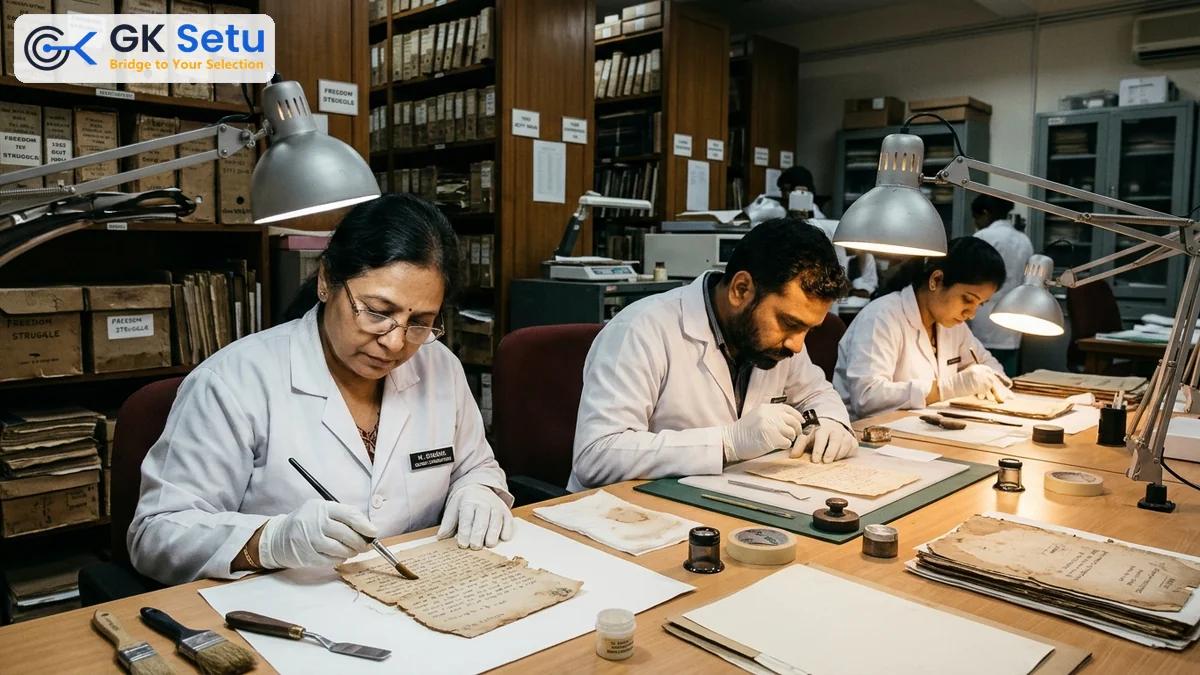
Key Exam Topics & Concepts Covered
- Statutory Archival Protocols: Legally binding regulations issued by the governing ministry to classify, preserve, and declassify historical records from the Indian National Movement (1857–1947). Exam Significance: Direct relevance for UPSC GS Paper-1 (Modern Indian History) and GS Paper-2 (Governance and Institutional Frameworks).
- National Movement Documentation Framework: The policy structure governing how primary sources—including trial records, colonial correspondence, and oral histories—are cataloged and made accessible to the public. Exam Significance: Vital for understanding historical sources, historiography, and heritage administration.
- Digital Heritage Integration: The systematic conversion of physical archival documents into machine-readable, searchable public indexes under unified governance standards. Exam Significance: High-yield context for questions on E-Governance, Cultural Preservation, and Educational Infrastructure.
The "What Happened Yesterday" Catalyst
On , the Ministry of Culture formally notified updated statutory guidelines and regulatory frameworks regarding the preservation, cataloging, and public dissemination of historical records concerning Modern India and the Freedom Struggle under the Indian History and National Movement domain.
The Executive Snapshot Hook
Imagine running a national railway network where every station uses a different timetable format, track gauge, and ticketing system. Finding a single train would require searching through hundreds of localized ledgers. For decades, researching the Indian Freedom Struggle faced a similar hurdle. Millions of colonial-era files, trial transcripts, and personal diaries lay scattered across disparate state archives and central repositories without a unified legal index.
The statutory updates notified on November 1, 2026, eliminate this friction by establishing a centralized, legally enforced regulatory framework. This mechanism creates a standardized methodology for preserving primary historical evidence—from the Revolt of 1857 to the Independence Act of 1947—ensuring both archival longevity and public access.
Vital Data Matrix
| Key Dimension | Verified Detail / Metric |
|---|---|
| Governing Authority | Ministry of Culture / National Archives of India |
| Regulatory Domain | Modern India & Freedom Struggle Statutory Guidelines |
| Notification Date | November 1, 2026 |
| Primary Target Period | Indian National Movement (1857–1947) & Post-1947 Consolidation |
| Core Beneficiaries | Research Scholars, Students, Exam Aspirants, and Academic Institutions |
The 3 Core Pillars of the Regulatory Framework
- Pillar 1: Standardized Declassification & Archival Indexing
- The new guidelines institute a mandatory timeline for reviewing and declassifying government files related to the national movement. By establishing explicit criteria for cataloging colonial Home Political records, intelligence briefs, and freedom fighter dossiers, the policy standardizes how historical documents are indexed across all regional archives.
- Pillar 2: Interoperable Digital Repository Standards
- To prevent data fragmentation, the regulatory framework enforces standardized metadata tags and high-resolution imaging benchmarks for digitizing primary sources. In practice, this shift functions much like converting paper banking passbooks into a real-time digital ledger. Crucially, rare documents—such as the proceedings of the Lahore Conspiracy Case or the original drafts of the 1930 Salt Satyagraha pamphlets—are search-indexed and retrievable via open-access platforms.
- Pillar 3: Academic & Institutional Integration
- The guidelines establish a direct channel between archival authorities and educational bodies. By creating verified digital resource packs mapped to standard syllabi, the framework ensures that competitive exam aspirants, history students, and researchers draw directly from authenticated primary sources rather than unverified secondary commentary.
Executive Summary & Future Outlook
Historically, archival records remained locked behind bureaucratic hurdles. The statutory updates notified on November 1, 2026, mark a structural evolution in how India manages its historical legacy. On the ground, combining rigid archival preservation rules with modernized digital access protocols enables the Ministry of Culture to transform historical documentation from passive storage into an active, transparent civic asset. Looking ahead, this framework guarantees systematic access to authenticated sources, ensuring that the study of Modern India and the Freedom Struggle remains grounded in rigorous, verified historical facts.