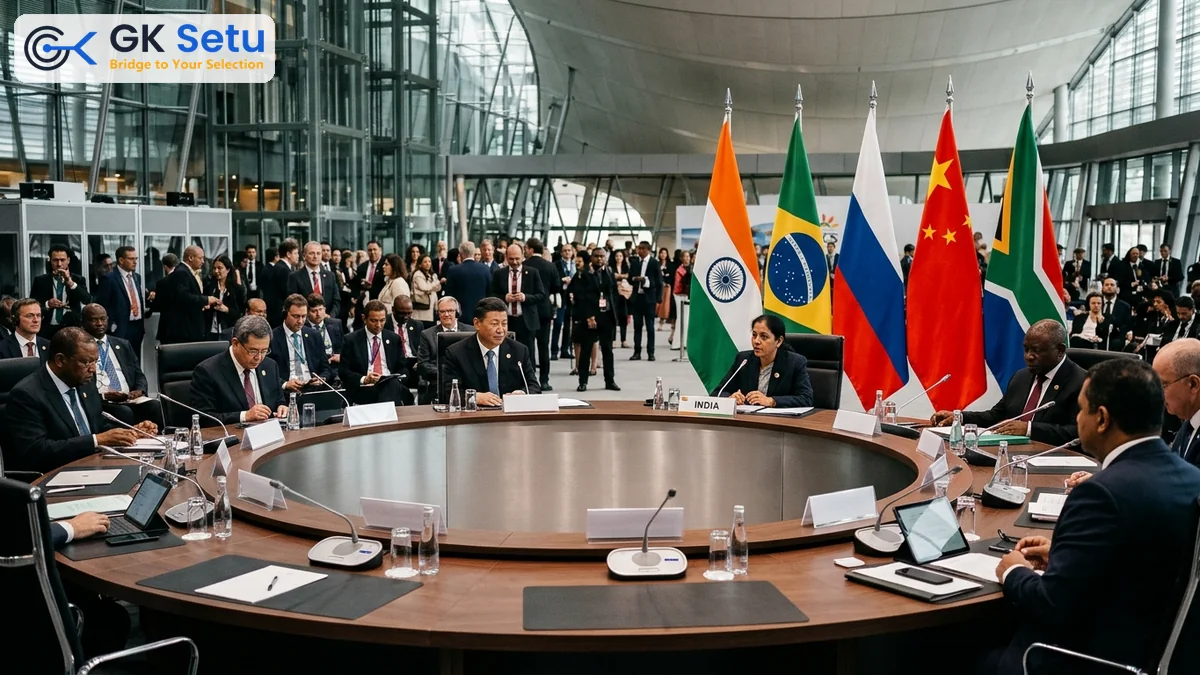
BRICS 2026: India Charts the Architecture of a Rebalanced Global Order
What Happened Yesterday
On November 4, 2026, the Ministry of External Affairs formally adopted the operational framework for India's upcoming presidency of the 18th BRICS Summit, establishing New Delhi's diplomatic priorities for the ten-nation grouping.
A Rebalanced Economic Landscape
Power shifts leave measurable statistical trails. Across ten capital cities, the expanded BRICS bloc commands 37.3% of global gross domestic product adjusted for purchasing power parity; it also controls over 43% of crude oil production worldwide. Following the entry of Egypt, Ethiopia, Iran, and the United Arab Emirates, the grouping accounts for more than 45% of the human population. The post-war presumption that international commerce must clear through a single hemisphere is giving way to distributed financial channels.
India assumes the rotating chair for the fourth time. Earlier tenures in 2012, 2016, and 2021 focused largely on institutional institution-building; by contrast, the 2026 agenda emphasizes concrete structural changes.
“The State shall endeavour to promote international peace and security; maintain just and honourable relations between nations; [and] encourage respect for international law and treaty obligations...”
— Article 51, Constitution of India
The Mechanics of Direct Clearing
Consider the logistical reality of commercial transactions. Indian buyers purchasing crude oil or exporting industrial equipment have routinely routed cross-border payments through Western correspondent banks. This arrangement extracts currency conversion fees and forces multi-day settlement cycles.
The 2026 summit framework aims to alter that pipeline. Establishing local-currency settlement mechanisms alongside interoperable digital rails like UPI can compress transaction overhead by 20% to 30%. In practice, funds settle directly between trade counterparts, removing third-party currency hops.
| Dimension | Conventional Clearing | Proposed BRICS Framework |
|---|---|---|
| Intermediary Currency | Third-party reserve fiat (USD/EUR) | Direct local currency pairs |
| Settlement Speed | T+2 to T+4 working days | Near-instantaneous digital ledger rails |
| Cost Friction | High spreads and correspondent margins | Estimated 20% to 30% reduction |
Structural Significance Across Domains
For Civil Services Aspirants
- Track the Chronology: Note the transition from a 2001 Goldman Sachs analytical paper to summit formalization in 2006, South Africa's induction in 2010, and the 2023 expansion.
- Syllabus Integration: Anchor GS-2 and GS-3 questions around three Indian summit anchors: counter-terrorism measures, Bretton Woods and UNSC structural reforms, and the internationalization of domestic Digital Public Infrastructure.
For Industry and Citizens
- Direct Merchant Margins: Lower fees directly help MSME exporters, independent technical service firms billing foreign accounts, and Indian households receiving inward remittances.
- Energy Price Resilience: Coordinated commercial arrangements across crude-producing members mitigate abrupt supply dislocations, stabilizing freight rates and wholesale pump prices at home.
Looking Ahead
Sovereign autonomy requires practical infrastructure. By anchoring emerging markets to open payment rails and equitable trade settlements, New Delhi aims to ensure that international governance reflects developing-world priorities.