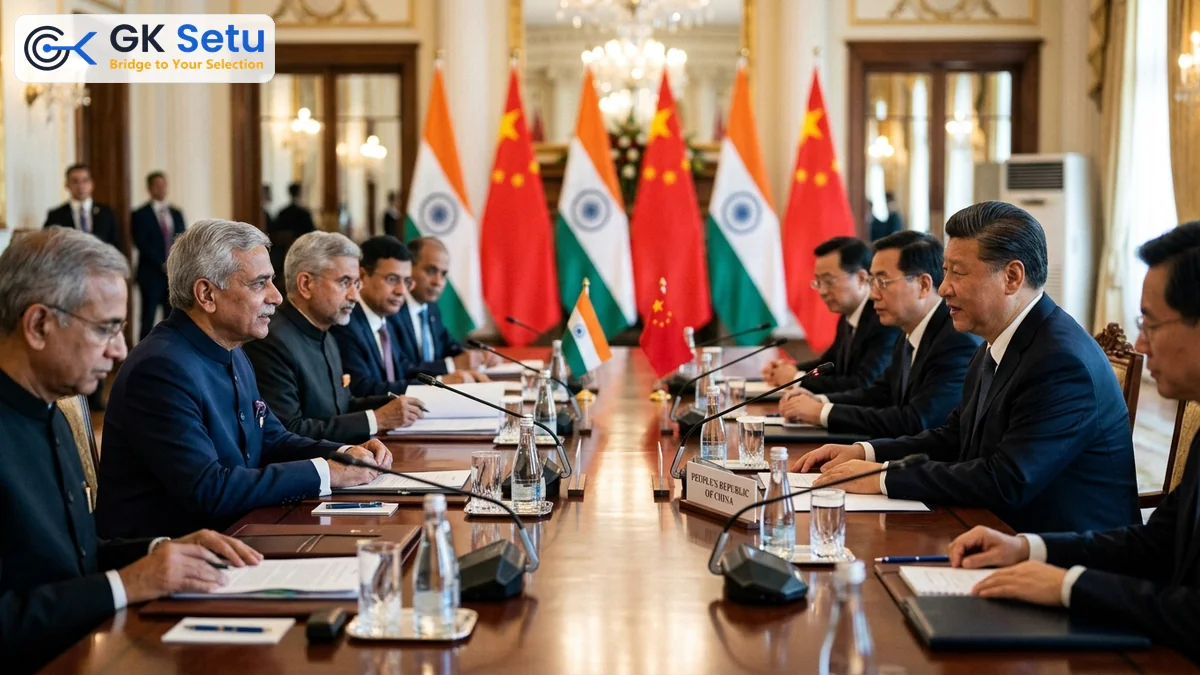
India-China Summit 2026: LAC De-escalation & Trade Talks
Key Exam Topics & Concepts Covered
- Article 51 of the Indian Constitution: A Directive Principle of State Policy (DPSP) instructing the State to promote international peace, maintain honorable inter-state relations, and encourage settlement of international disputes by arbitration. (Relevance: General Studies II - Polity & International Relations)
- Line of Actual Control (LAC): The 3,488 km un-demarcated boundary separating Indian-controlled territory from Chinese-controlled territory. (Relevance: General Studies III - Border Management & Security)
- Non-Tariff Barriers (NTBs): Regulatory and administrative restrictions—including complex licensing, stringent quality standards, and customs clearance delays—that restrict import volumes without direct import taxes. (Relevance: General Studies III - Indian Economy & Global Trade)
The "What Happened Yesterday" Catalyst
On September 12, 2026, Indian Prime Minister Narendra Modi and Chinese President Xi Jinping held high-level bilateral talks to reactivate diplomatic dialogue, streamline commercial engagement, and establish stable military de-escalation mechanisms along the Line of Actual Control.
The Big Question Hook
Border friction persists. Trade expands regardless.
How do two nuclear-armed Asian giants share a volatile 3,488 km border, exchange over $135 billion in goods annually, and still manage to de-escalate operational military standoffs? In practice, sovereign nations must balance territorial integrity with national economic interest without compromising strategic defense postures.
The "Why It Matters" Deep-Dive
Historically, the June 2020 Galwan Valley military clash froze political dialogue between New Delhi and Beijing. High-altitude deployments expanded rapidly along the LAC; diplomatic hotlines fell silent, while customs scrutiny tightened on cross-border shipments.
Crucially, commercial reality asserted itself. Bilateral trade surpassed $135 billion in recent fiscal cycles. India depends on active pharmaceutical ingredients (APIs), key electronic components, and heavy industrial machinery; by contrast, Chinese manufacturers rely on the vast Indian domestic market for finished goods.
                [ JUNE 2020 ]
        Galwan Valley Border Standoff
                      │
                      ▼
          Diplomatic Channels Frozen
       Bilateral Friction & LAC Mobilisation
                      │
                      ▼
          [ SEPT 12, 2026 SUMMIT ]
   PM Modi & President Xi Bilateral Meeting
                      │
       ┌──────────────┴──────────────┐
       ▼                             ▼
Military De-escalation      Trade & NTB Reduction
  (3,488 km LAC)            ($135B+ Ecosystem)
Why did both leaderships execute this diplomatic pivot on September 12, 2026? Three core structural imperatives explain the strategic turn:
- Border Security Meets Operational Reality: Maintaining high-altitude troop deployments across an un-demarcated 3,488 km line consumes billions in defense logistics while heightening accidental conflict risks. Enforceable de-escalation protocols establish predictable operational boundaries.
- Economic Pragmatism: Non-tariff administrative bottlenecks had choked vital supply chains for domestic manufacturers. Addressing custom delays reduces industrial input costs and stabilizes market expectations.
- Constitutional Alignment: India's foreign policy reflects the directive principles enshrined in Article 51 of the Constitution, which mandates international peace promotion and dispute settlement via negotiation—even while defense forces maintain robust sovereign deterrence along front-line posts.
Jargon Buster / Key Terms Explained
- Line of Actual Control (LAC):
- An operational boundary dividing Indian and Chinese controlled territories where no mutually agreed physical demarcation exists on ground maps.
- Non-Tariff Barriers (NTBs):
- Administrative hurdles such as inspection delays, restrictive technical specifications, and licensing bottlenecks that hinder trade volume without imposing direct customs duties.
- De-escalation Mechanism:
- Structured, military-to-military communication protocols designed to pull back front-line forces to agreed staging zones and resolve localized patrol friction through direct hotlines.
What Comes Next?
| Phase | Action Item | Strategic Objective |
|---|---|---|
| 1. Military Verification | Joint verification of patrol buffer zones along 3,488 km LAC. | Prevent accidental skirmishes between front-line patrols. |
| 2. Trade Barrier Audits | Customs clearing review for the $135B+ trade flow. | Eliminate regulatory bottlenecks and lower industrial input costs. |
| 3. Special Representative Talks | Reactivation of formal diplomatic boundary negotiations. | Formulate long-term boundary resolution frameworks. |