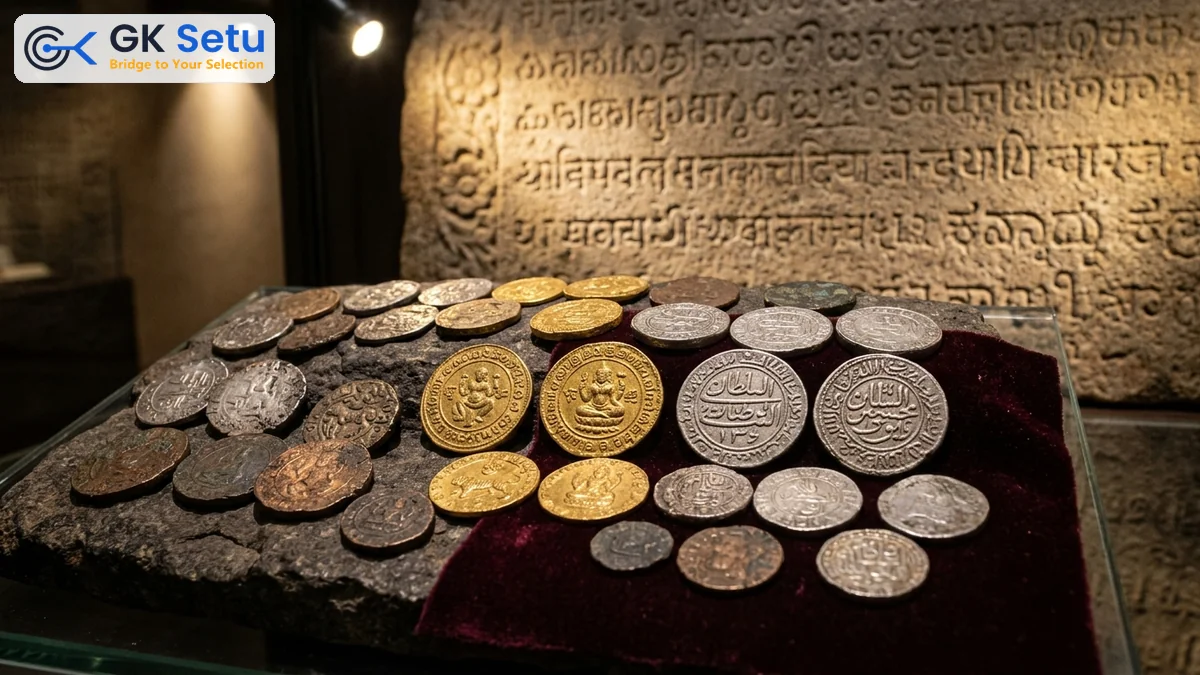
Reconstructing Medieval India Through Inscriptions and Coins
The "What Happened Yesterday" Catalyst
On November 21, 2026, commentary published in The Sentinel sparked a national debate among historians and policymakers on re-evaluating Medieval Indian governance through empirical epigraphic evidence. Notably, this discussion coincided with the conclusion of a 22-day public exposition of the Holy Relics of Lord Buddha in Arunachal Pradesh.
Unlocking Medieval India's Economic Blueprint
Facts demand empirical proof. Instead of viewing pre-modern history through ideological lenses, modern research examines tax records carved into thousand-year-old granite walls and analyzes the metal purity of regional coinage. Historically, the millennium spanning the rise of the Imperial Cholas, the expansion of the Vijayanagara state, the Mughal administrative apparatus, and the Maratha Confederacy suffered from overgeneralized narratives. Today, rigorous archival data is correcting those historical gaps.
Academic research across states like Karnataka is moving away from colonial frameworks. Researchers rely on tangible evidence; they examine how local agrarian markets operated, how temple endowments acted as institutional credit hubs, and how administrative law maintained trade stability. Crucially, public interest remains strong. Events like the Buddha Relics exposition demonstrate a deep social connection to living heritage. Preserving this physical record requires robust enforcement of legal protections under the Ancient Monuments and Archaeological Sites and Remains (AMASR) Act of 1958.
"Evaluating medieval administrative structures, agrarian trade, and temple endowments requires moving past speculative frameworks toward empirical epigraphic and numismatic evidence under statutory protections like the AMASR Act of 1958."
— The Sentinel Analysis on Historiography, November 21, 2026
Practical Implications for Examinations and Policy
This empirical turn changes how students approach history and how citizens interact with public heritage. On the ground, data replaces conjecture.
| User Group | Primary Focus Area | Actionable Key Takeaway |
|---|---|---|
| Competitive Exam Aspirants | GS Paper I & History Elective | Focus on empirical sources like the Uttiramerur Chola Sabha inscriptions and Vijayanagara Nayakanga fiscal records. Master the statutory provisions of the AMASR Act, 1958. |
| Professionals & Citizens | Heritage Preservation & Policy | Recognize that scientifically conserved sites strengthen local tourism economies. Use raw historical data as a template for objective policy analysis. |
The Big-Picture Horizon
Technology now accelerates historical discovery. Researchers combine satellite mapping, metallurgical coin scans, and optical character recognition for inscriptions. By grounding pre-modern history in physical facts and legal conservation frameworks, India establishes a verifiable foundation for its institutional past.