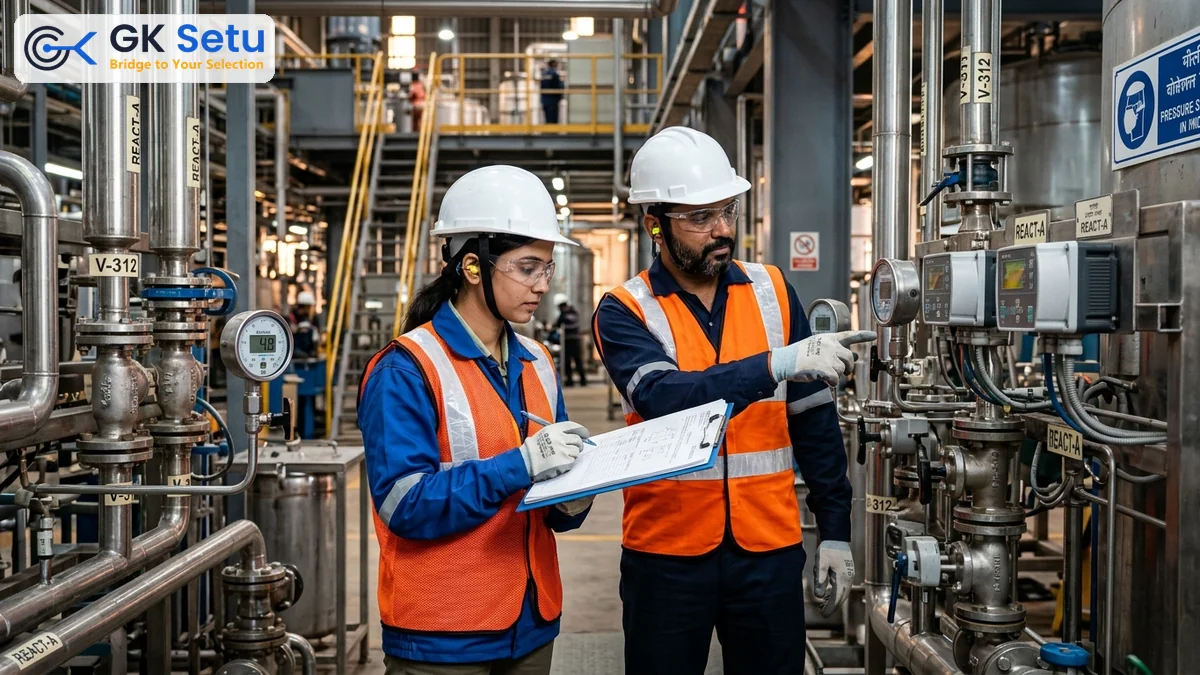
Key Exam Topics & Concepts Covered
- Chemical Safety & Statutory Framework: Administrative rules governing substance handling, hazard classification, and environmental compliance across industrial and academic labs.
- Department of Chemicals and Petrochemicals (DCPC): The nodal executive agency drafting policies, standardizing safety protocols, and monitoring chemical handling systems nationwide.
What Happened Yesterday: Statutory Protocols Updated
On , the government officially notified updated statutory regulations under the General Science & Technology mandate. The policy enforces standardized operational protocols across research laboratories and manufacturing hubs.
The Everyday Analogy: A Molecular Traffic Control System
Imagine a sprawling megacity carrying millions of fast vehicles. Without traffic lights, lane markers, or speed enforcement, vehicles crash; urban movement stops completely. Chemistry operates under identical dynamics.
Molecules, industrial solvents, and laboratory reagents behave like high-speed vehicles. Statutory rules act as traffic signals. Crucially, clear lane assignments and storage thresholds prevent contamination without choking laboratory innovation.
The 3-Tier Governance Architecture
Tier 1: Leadership & Strategic Oversight
The Ministry of Chemicals and Fertilizers joins forces with the Department of Scientific and Industrial Research (DSIR) at the top governance tier.
- Policy Formulation: Executives establish unified baseline parameters for chemical authorization, toxicity metrics, and exposure limits.
- Global Standards: Frameworks match the Globally Harmonized System (GHS) of Classification and Labelling of Chemicals; exports remain competitive worldwide.
- Hazard Prevention: Apex authorities mandate mandatory environmental audits, green chemistry metrics, and strict transport rules for hazardous materials.
Tier 2: The Regulatory Transmission Pipeline
Notified protocols flow directly to state authorities and technical inspectorates.
[Apex Policy Directives (DCPC / DSIR)]
                │
                ▼
[State Pollution Control Boards (SPCBs) & Regulatory Inspectors]
                │
                ▼
[Academic Labs, Industrial Hubs & Testing Facilities]- Monitoring and Compliance: State Pollution Control Boards enforce Material Safety Data Sheets (MSDS) across all active processing plants.
- Technical Oversight: Inspection teams verify spill-containment infrastructure; non-compliant facilities face rapid suspension.
- Capacity Building: Technical workshops translate legal jargon into clear, actionable workplace checklists for technicians.
Tier 3: Grassroots Operational Impact
On the ground, these rules protect workers, students, and neighboring communities.
- Academic Benchmarks: University laboratories install mandatory fume hoods, emergency showers, and safe storage cabinets for reactive reagents.
- Environmental Protection: Local populations residing near industrial corridors gain immunity from illegal chemical dumps and toxic emissions.
- Consumer Quality: Rigorous compliance guarantees that commercial agrochemicals and pharmaceuticals remain free of hazardous contaminants.
Fast Facts Grid
| Operational Parameter | Policy Specification |
|---|---|
| Nodal Authority | Department of Chemicals & Petrochemicals (DCPC) / Ministry of Chemicals & Fertilizers |
| Regulatory Scope | Statutory Handling Standards, Industrial Safety Rules, & Hazard Classification |
| Notification Date | November 22, 2026 |