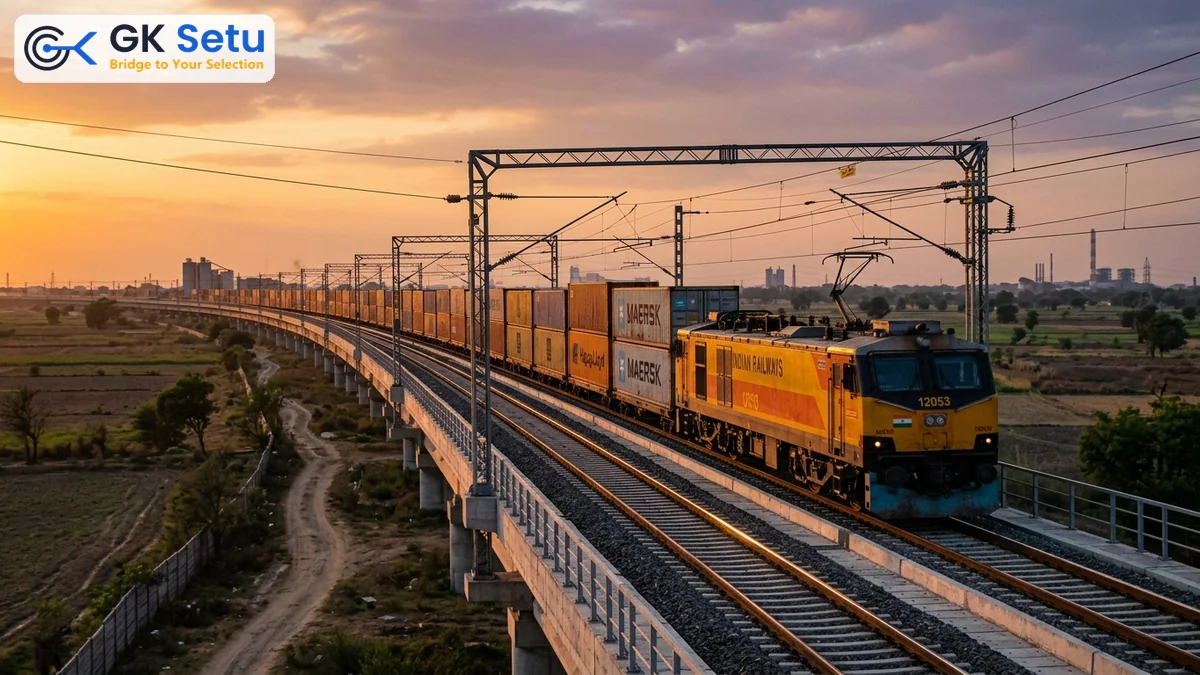
The New Arteries of Indian Trade
On November 23, 2026, the Ministry of Railways inaugurated the first 450-kilometer stretch of the National High-Speed Freight Corridor (NHSFC). This development marks a shift toward dedicated, high-velocity industrial transport.
Think of a congested city highway. A slow delivery truck blocks a bicycle. The bicycle cannot accelerate; the truck struggles in stop-and-go traffic. For decades, Indian Railways faced this exact bottleneck. Passenger and freight trains shared the same tracks. The NHSFC acts as an exclusive expressway for heavy cargo. It clears the main line, allowing both passenger and freight trains to maintain optimal speeds.
The 3-Tier Layered Blueprint
The NHSFC serves as the operational muscle for the PM Gati Shakti National Master Plan. Under the Ministry of Railways, the project aims to support the Viksit Bharat 2047 vision. The strategy decouples freight from passenger traffic. By creating a specialized network, the government re-engineers the supply chain to reduce logistics costs by 14 percent.
The technical backbone relies on two upgrades. First, the infrastructure supports a 25-tonne axle load capacity. This represents a 15 percent increase over legacy standards, facilitating heavier shipments of coal and steel. Second, an automated signaling system manages 12 new smart-stations. This system acts as a traffic brain, increasing track capacity by 65 percent while enabling speeds exceeding 100 km/h.
For the average citizen, this means lower prices. When logistics costs drop, the cost of goods—from construction steel to food items—decreases. For the economy, this provides a blueprint for sustainable industrial growth while lowering the carbon footprint.
| Category | Specification |
|---|---|
| Nodal Authority | Ministry of Railways |
| Operational Stretch | 450 Kilometers |
| Logistics Cost Reduction | 14 Percent |
| Axle Load Capacity | 25 Tonnes |
| Track Capacity Increase | 65 Percent |