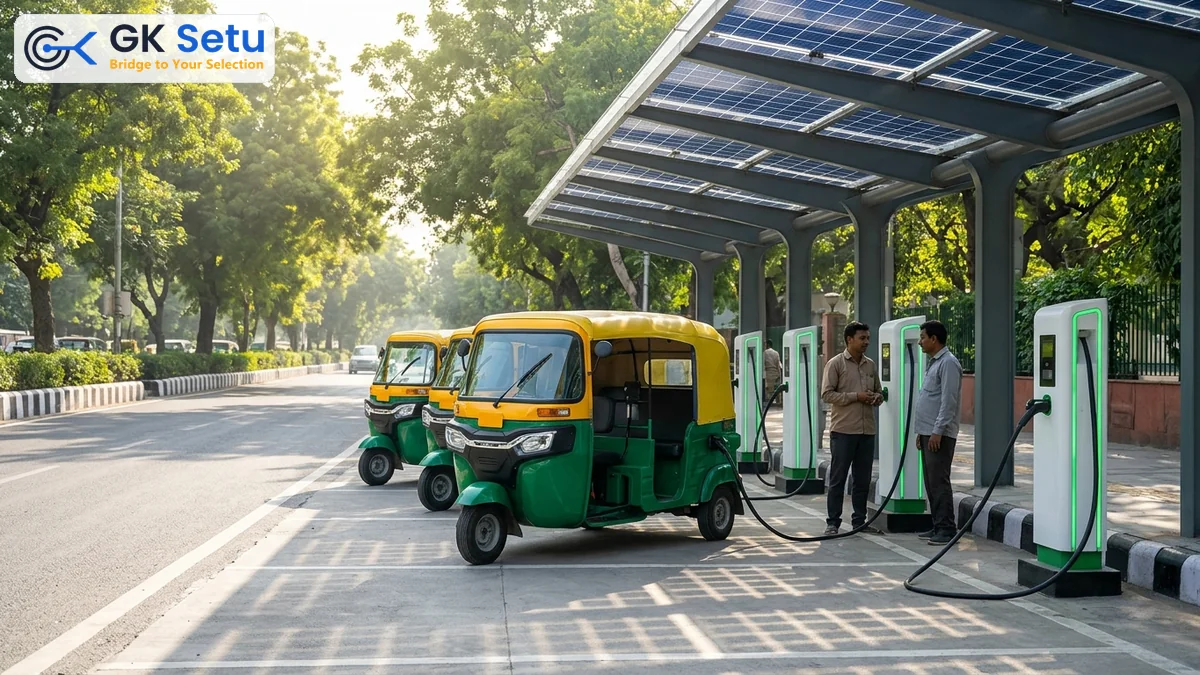
Delhi Rolls Out Rs 50,000 EV Auto Subsidy
- Electric Vehicle (EV) Subsidies & Demand Incentives: Direct financial grants provided by governments to reduce the high initial capital cost of zero-emission commercial transport, crucial for competitive exams under sustainable urban development and environmental economics.
- Urban Air Quality Mitigation & E-Mobility: Policy frameworks designed to accelerate the transition from Internal Combustion Engine (ICE) vehicles to battery-electric models, directly impacting national carbon emission targets and particulate matter reduction in metropolitan regions.
On November 25, 2026, the Delhi government announced a direct financial incentive of Rs 50,000 for citizens purchasing an electric auto, marking a strategic escalation in the capital's clean mobility campaign.
The Executive Snapshot Hook
Imagine navigating the bustling, congested arteries of India’s national capital, where thousands of diesel and compressed natural gas auto-rickshaws form the backbone of daily last-mile connectivity—while quietly pumping stubborn particulate matter into the winter haze. On November 25, 2026, the Delhi government altered this daily equation by introducing a targeted financial incentive of Rs 50,000 for the purchase of new electric auto-rickshaws. This policy intervention is not merely a localized transport update; it is a high-impact economic lever designed to make zero-emission commercial mobility financially irresistible for everyday earners.
Vital Data Matrix
| Key Dimension | Verified Detail / Metric |
|---|---|
| Governing Authority | Delhi Government (Transport Department) |
| Financial Outlay / Scale | Rs 50,000 per vehicle subsidy |
| Timeframe / Deadline | Initiated on November 25, 2026 (Ongoing rollout) |
| Primary Beneficiary / Target | Auto-rickshaw drivers, owners, and commercial fleet buyers in Delhi |
3 Core Pillars
- Pillar 1: Overcoming High Initial Capital Barriers
While electric vehicles save money on daily fueling and maintenance over time, their upfront purchase price is often higher than traditional Internal Combustion Engine vehicles. Think of it like buying an energy-efficient air conditioner that costs more at the store but slashes your monthly electricity bill; the Rs 50,000 government subsidy acts as an instant price discount, bridging the affordability gap for working-class auto drivers. - Pillar 2: Direct Attack on Vehicular Particulate Pollution
Commercial transport operates virtually around the clock, meaning a single auto-rickshaw burns far more fuel and covers significantly more distance daily than a private family car. By targeting commercial auto-rickshaws rather than private vehicles, municipal planners maximize their environmental return on investment, directly cutting down high-density carbon emissions and toxic particulate matter in India's most congested metropolitan zones. - Pillar 3: Integration with Broader Decarbonization Mandates
This localized financial incentive sits within a larger matrix of national and state-level green policies aimed at fulfilling India's broader climate commitments. Transitioning urban public and commercial transit to electric mobility ensures that economic livelihood and ecological preservation move forward hand-in-hand, creating a sustainable blueprint for other fast-growing Indian urban centers to replicate.
The Executive Summary Takeaway
The Delhi administration's rollout of the Rs 50,000 electric auto purchase incentive on November 25, 2026, exemplifies modern policy engineering: it uses direct fiscal stimulus to align individual economic self-interest with macro-level environmental goals. By easing the financial burden on commercial drivers, the policy accelerates the displacement of polluting fossil-fuel engines, proving that effective climate action in densely populated economies relies as much on smart economics as it does on environmental vision.