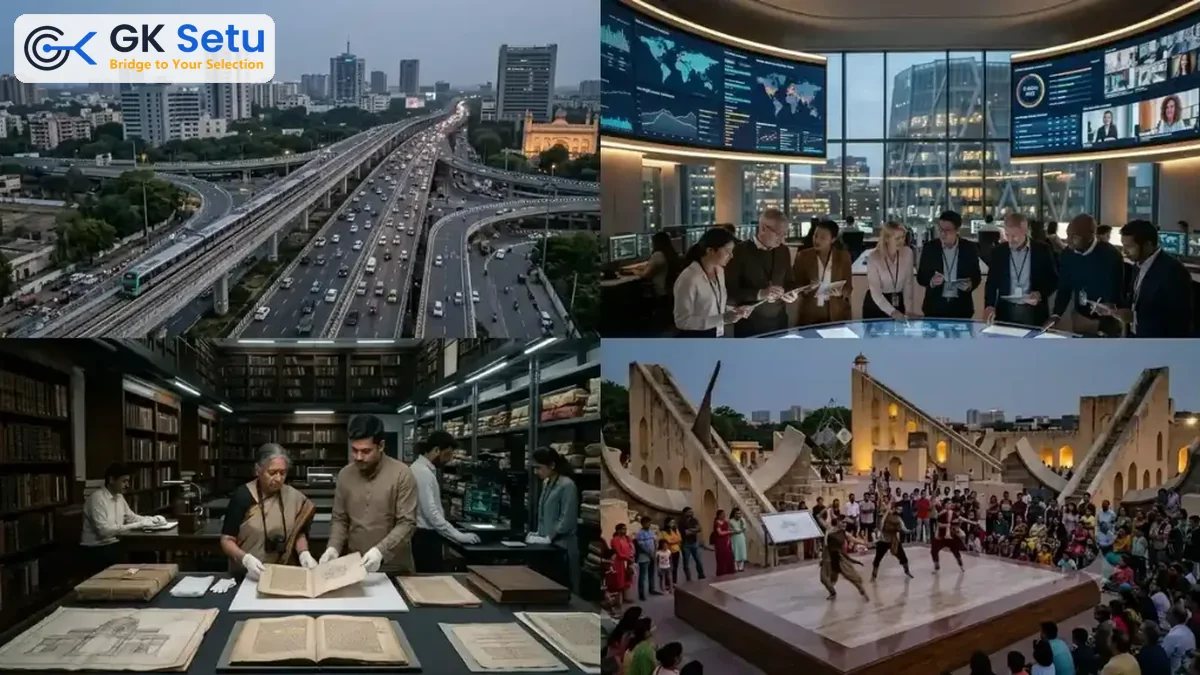
Daily Current Affairs & Editorial Synthesis: 29 October 2026
An exhaustive analysis of India's latest policy updates across cultural heritage conservation, digital media governance under the IT Rules 2021, and high-speed urban transit infrastructure.
Executive Cheat Sheet & Rapid Snapshot
| Core Topic | Domain / Syllabus Relevance | Yesterday's Catalyst & Hard Facts | Full Analysis |
|---|---|---|---|
| Revised Literature & Heritage Guidelines | GS Paper I: Indian Culture & Heritage Preservation | Ministry of Culture issued updated directives for institutional grants, archival digitization, and indigenous literary translation projects. | Read Full Analysis → |
| India Biennale at Jantar Mantar | GS Paper I: Visual & Performing Arts; Ancient Monuments Act | ASI approved temporary performance art staging at Jantar Mantar under regulated frameworks of the AMASR Act 1958. | Read Full Analysis → |
| OTT Market Dynamics & IT Rules 2021 | GS Paper II & III: Governance, Media Regulation & Digital Economy | Regulatory review of three-tier grievance redressal mechanisms and self-regulatory bodies governing digital streaming platforms. | Read Full Analysis → |
| Urban Expressway Transit Expansion | GS Paper III: Infrastructure, Economic Growth & Urbanization | Unveiling of access-controlled metropolitan expressway projects designed to reduce logistics overheads and transit delays. | Read Full Analysis → |
Pillar I: Culture, Preservation & Architectural Legacies
The Ministry of Culture has restructured its policy framework for safeguarding classical literature and tangible monuments. Through the notification of India Notifies Revised Literature and Heritage Guidelines, the central government established unified norms for direct financial aid to literary societies, digital archiving of rare manuscripts, and standardized translation workflows across scheduled languages.
Cultural preservation requires structural funding combined with statutory safeguards to balance public access with physical heritage protection.
Simultaneously, spatial integration of live art within historic structures is being tested. Under strict regulatory oversight, the selection of historical monuments for contemporary cultural events—detailed in Jantar Mantar to Host India Biennale Performing Arts—demonstrates how the Ancient Monuments and Archaeological Sites and Remains (AMASR) Act 1958 accommodates public participation without compromising structural integrity.
Pillar II: Digital Governance & Media Economics
Rapid consolidation in the Over-The-Top (OTT) streaming sector has brought regulatory mechanisms back into focus. The operational enforcement of the Information Technology (Intermediary Guidelines and Digital Media Ethics Code) Rules 2021 provides a structured compliance model for digital content publishers.
As outlined in OTT Market Dynamics and the Mechanics of IT Rules 2021, the three-tier grievance redressal framework—comprising publisher self-regulation, self-regulatory bodies headed by retired judicial authorities, and an oversight mechanism by the Ministry of Information and Broadcasting—ensures accountability while preserving artistic freedom.
Pillar III: Infrastructure Development & Transit Efficiency
Economic expansion relies heavily on high-throughput transport corridors. Metropolitan centers continue to face severe traffic congestion, leading to lost economic output and increased carbon emissions. The launching of grade-separated urban expressways addresses structural bottlenecks in industrial supply chains.
According to India Unveils New Urban Expressway to Ease Transit, the integration of Intelligent Transport Systems (ITS), automated tolling, and dedicated freight lanes aims to lower logistics costs below 9 percent of Gross Domestic Product, reinforcing national connectivity goals.