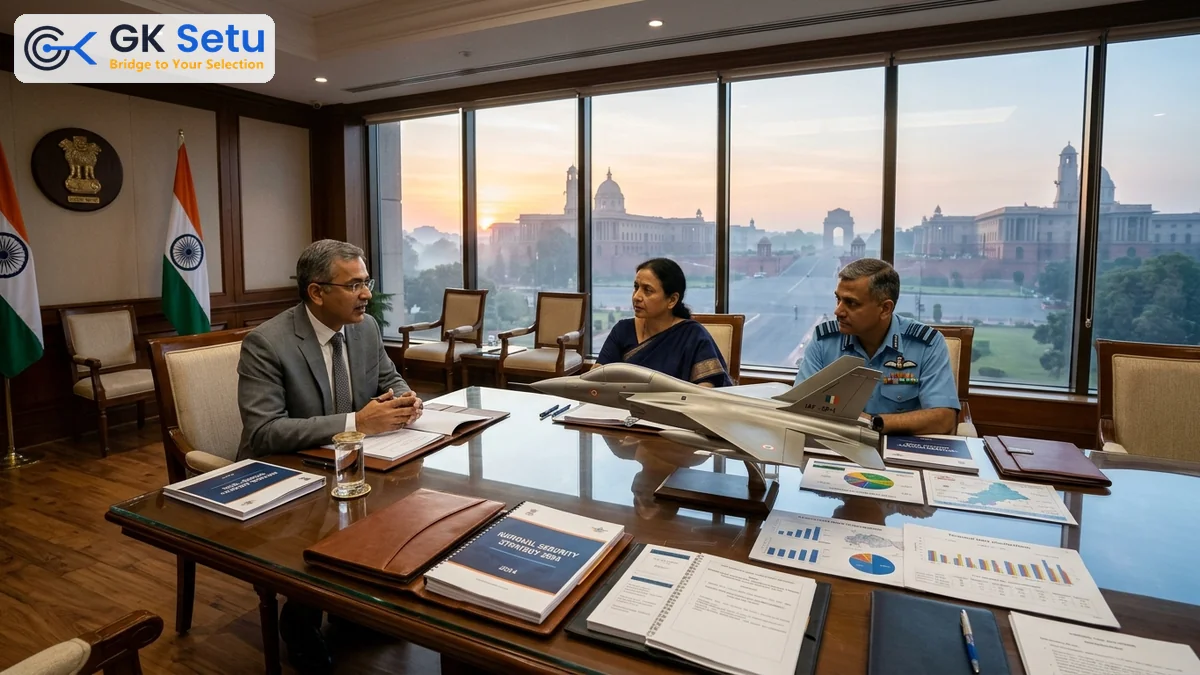
Daily Master Current Affairs & Editorial Synthesis: 14 November 2026
A consolidated institutional synthesis of state-led insurance modernization, advanced dual-use defense platforms, and structural macroeconomic policy synchronization across the Indian Union.
Executive Daily Cheat Sheet
| Core Topic | Domain / Syllabus Relevance | Yesterday's Catalyst & Hard Facts | Full Analysis |
|---|---|---|---|
| Dual-Use eVTOL & Defense Aviation Shift | GS Paper III: Science & Technology, Indigenization, Security Challenges along Borders | DGCA airworthiness certifications align with MoD fast-track procurement for high-altitude logistics (LAC/LOC) operating above 14,000 feet. | Read Full Analysis → |
| Public Insurance Institutional Governance (NICL Scale-I) | GS Paper II & III: Statutory Bodies, Public Sector Undertakings, Financial Inclusion | National Insurance Company Limited initiates Scale-I recruitment, reinforcing underwriting solvency margins under IRDAI guidelines and GIBNA 1972 mandates. | Read Full Analysis → |
| Macroeconomic Policy Synchronization | GS Paper III: Indian Economy, Fiscal Deficit Targets, Monetary Policy Transmission | Consensus framework aligns FRBM-mandated debt glidepaths (below 4.5% of GDP) with RBI Liquidity Adjustment Facility corridors to prevent bond crowding-out. | Read Full Analysis → |
Pillar 1: Defense Modernization & Indigenization
Technological convergence bridges commercial logistics and strategic defense doctrines. In an era marked by complex border frictions, the line separating commercial aerospace innovation from tactical frontline readiness has dissolved. India's recent regulatory fast-tracking demonstrates how urban air mobility and electric vertical take-off and landing systems are being absorbed directly into combat doctrines.
High-altitude logistics require specialized thrust dynamics. The Indian Armed Forces operate in forward zones along the Line of Actual Control (LAC) and Line of Control (LOC) where traditional rotorcraft face aerodynamic lift degradation and thermal strain. By adopting hybridized power architectures, military planners address last-mile supply lines to forward outposts sitting beyond 14,000 feet. Readers can examine the complete technical breakdown in our report on how Dual-Use Tech Redefines Civilian and Defense Aviation.
"Defense capital procurement no longer exists in an isolated silo; civil-military fusion determines operational logistics and airspace deterrence simultaneously."
Pillar 2: Public Sector Financial Institutions & Governance
Financial resilience depends on public underwriting health. India's state-owned general insurance sector operates under statutory obligations established by the General Insurance Business (Nationalisation) Act, 1972 (GIBNA). These institutions manage systemic risk across agricultural crop protection, industrial guarantees, and subsidized universal health coverage.
Institutional capacity mandates human capital rejuvenation. The operational expansion spearheaded by the National Insurance Company Limited underscores regulatory compliance with Insurance Regulatory and Development Authority of India (IRDAI) solvency benchmarks. Maintaining a statutory solvency ratio above the mandated 150% requires precise technical underwriting, actuarial reserves, and clean claim settlement ratios. For a granular breakdown of statutory mandates, administrative oversight, and exam-relevant governance mechanics, see NICL Scale-I Recruitment: Structure, Governance, and Impact.
Pillar 3: Macroeconomic Architecture & Policy Cohesion
Macroeconomic stability requires synchronized governance levers. When the Union Government expands public capital expenditure while the Reserve Bank of India manages stubborn headline consumer price pressures, policy divergence risks elevating sovereign borrowing costs. The solution lies in structured coordination between North Block and Mint Street.
Fiscal consolidation protects private investment cycles. The central government's commitment to bring the fiscal deficit below 4.5% of Gross Domestic Product (GDP) relieves pressure on the domestic debt market. When market borrowings are managed alongside the RBI's variable rate repo operations and open market portfolios, yields on 10-year benchmark government securities remain stable. This programmatic institutional synergy is unpacked in our assessment of Synchronizing Fiscal and Monetary Levers in India.