Key Exam Topics & Concepts Covered
- Project of National Importance (2002): A statutory classification for mega-infrastructure projects of strategic, regional, and economic priority, unlocking dedicated federal funding and inter-ministerial oversight.
- Article 307 of the Indian Constitution: A constitutional provision empowering Parliament to appoint an authority to enforce and maintain the freedom of trade, commerce, and intercourse across state and regional boundaries.
- Seismic Zone-V Engineering: The highest earthquake-risk classification in India, requiring specialized structural designs capable of absorbing severe ground acceleration and dynamic tectonic stress.
- The Railways Act, 1989: The primary statutory framework governing land acquisition, safety certification, construction standards, and operational mandates across Indian Railways.
What Happened Yesterday
On October 31, 2026, the Ministry of Railways announced the full commercial operationalization of the ₹41,119 crore, 272-km Udhampur-Srinagar-Baramulla Rail Link (USBRL) project, establishing India's first all-weather direct railway network into the Kashmir Valley.
The Opening Scene: Conquering the Impassable Pir Panjal
Winter along National Highway 44 was historically merciless. Landslides choked narrow Himalayan passes across the Pir Panjal range. Freight trucks stood motionless for days. Apple harvests froze in transit. Winter isolation was a harsh geographical tax paid by local residents for decades.
Steel rails changed that reality. Laying track here meant fighting dynamic geology across the Reasi thrust zone, where young mountains shift continuously. Construction proceeded under the statutory authority of the Railways Act, 1989. Engineers bored through unstable rock, spanned deep chasms, and built structures calculated to endure violent Himalayan gales.
Visual Timeline: The 24-Year Engineering Journey
- 2002 — Project of National Importance Declared: Parliament classified the USBRL line to ensure uninterrupted central funding and integrate the Kashmir Valley into national supply chains.
- February 2022 — Breakthrough at Tunnel T-49: Mining crews completed Tunnel T-49. At 12.77 km, it became India's longest railway tunnel, anchoring an underground network spanning 38 separate tunnels over 119 km.
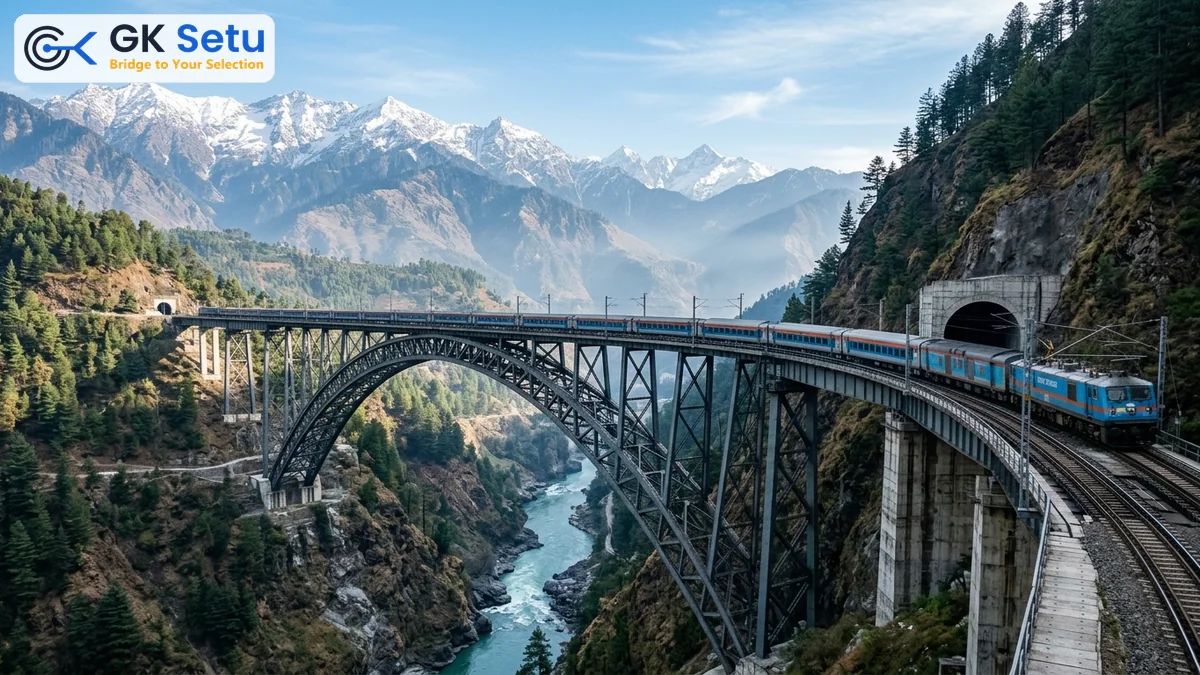
- August 2022 — Steel Arch of Chenab Bridge Completed: Engineers closed the main steel arch over the Chenab riverbed. Rising 359 metres above the water, the bridge towers 35 metres above Paris's Eiffel Tower and consumed 28,660 metric tonnes of structural steel.
- October 31, 2026 — Commercial Operationalization Delivered: Trains began running across the complete 272-km corridor, reducing travel time between Jammu and Srinagar from 7 hours by road to under 3.5 hours by rail.
The Horizon Ahead: Economic and Strategic Logistics
Operational rail traffic across the Pir Panjal marks a structural realignment for North India's freight corridors.
| Parameter | Project Specification |
|---|---|
| Total Sanctioned Cost | ₹41,119 Crore |
| Total Route Length | 272 Km |
| Travel Time (Jammu to Srinagar) | Reduced from 7 hours to under 3.5 hours |
| Underground Tunnel Network | 119 Km spanning 38 Tunnels |
| Highest Structural Point | 359-metre Chenab Arch Bridge |
Freight trains now run continuously. Crucially, regional produce reach consumer centers in Delhi and Mumbai within hours. Fresh fruit losses drop significantly. Beyond civilian mobility, this all-weather track secures defense logistics year-round across sensitive northern border zones.