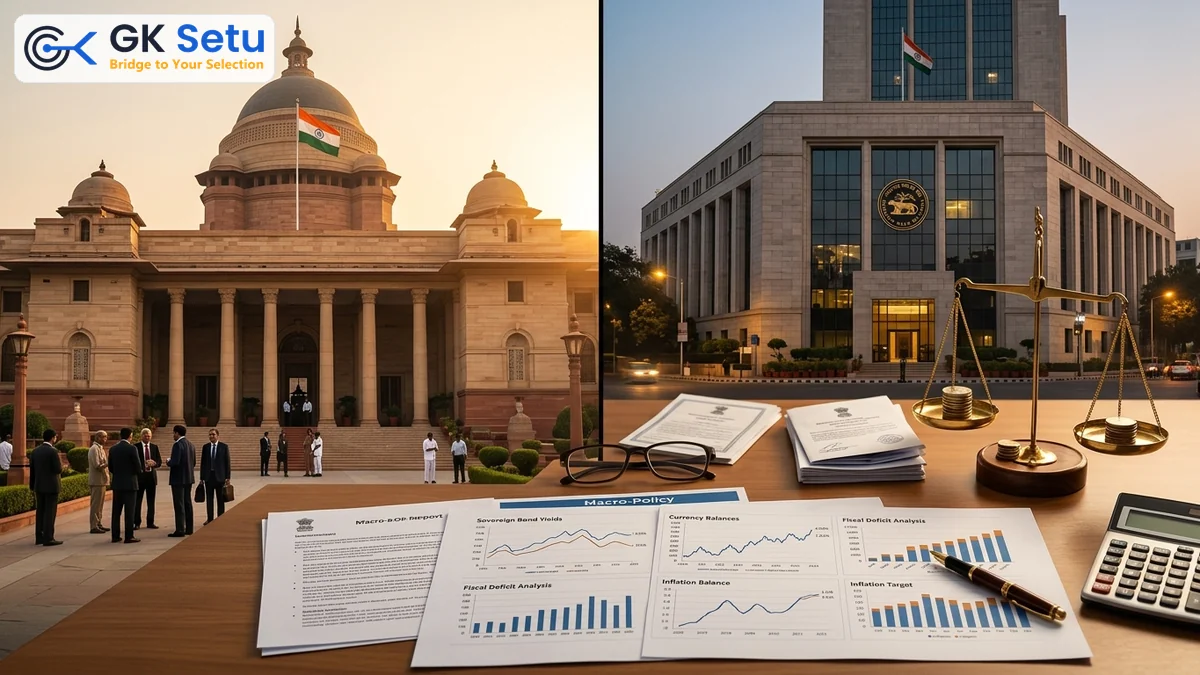
Balancing India's Fiscal and Monetary Engines
Key Exam Topics & Concepts Covered
- Fiscal Responsibility and Budget Management (FRBM) Act: The legislative framework governing India's fiscal discipline, capping public debt and fiscal deficits to ensure macroeconomic stability.
- Flexible Inflation Targeting (FIT) / RBI Act, 1934: The mandate empowering the Reserve Bank of India to maintain price stability while keeping growth in mind, recommended originally by the Urjit Patel Committee.
- Repo Rate (5.25%): The benchmark interest rate at which the central bank lends money to commercial banks, directly influencing business and consumer credit costs.
- Real GDP Growth (7% for FY27): The inflation-adjusted measure of the total monetary value of all goods and services produced within India, serving as the ultimate health check of the economy.
The Catalyst: On November 12, 2026, global rating agency Moody's officially pegged India's projected real GDP growth for FY27 at 7%, anchored by robust private consumption and accelerating capital expenditure.
The Opening Scene
Imagine standing in a high-stakes control room where two veteran engineers steer a massive locomotive. One engineer, the Ministry of Finance, handles the throttle by injecting coal via public spending and tax policies. The other, the Reserve Bank of India, handles the brakes and gears by adjusting interest rates to keep the engine from overheating.
This dual-engine machinery emerged from historic balance-of-payment crises, legislative overhauls like the FRBM Act, and institutional reforms born from the Urjit Patel Committee. Today, this machinery defines how 1.4 billion people experience economic reality, bridging state-driven infrastructure investments and everyday household kitchen budgets.
Milestone Sequence
- 1934 — Legislative Foundation: The Reserve Bank of India Act, 1934, laid the legal groundwork for India's central banking system.
- 2003 — Fiscal Discipline Era: Parliament enacted the FRBM Act to institutionalize fiscal discipline, mandate transparency, and eliminate revenue deficits.
- 2016 — Inflation Targeting Framework: India legally adopted the Flexible Inflation Targeting framework, anchoring the RBI's primary objective around consumer price stability at 4% with a plus-minus 2% band.
- April–June 2026 — Q1 Investment Surge: India recorded a real GDP growth rate of 7.8% during the April–June quarter, driven by an investment surge and private consumption.
- November 12, 2026 — Current Benchmark: Moody's elevated India's projected real GDP growth for FY27 to 7%, supported by a regional ceasefire and a retreat in international crude oil prices.
Concept Decoded: Fiscal vs. Monetary Policy
Think of the economy as a residential building under construction. Fiscal Policy is managed by the government through the Union Budget, deciding how much concrete and labor to buy by collecting taxes and spending on public infrastructure. Monetary Policy is managed by the central bank, regulating the flow of credit by tightening or loosening lending valves through the 5.25% repo rate. When the builder spends wisely and the central bank regulates credit fairly, the building rises safely without structural cracks.
The Horizon Ahead
Looking past the immediate horizon, India's macroeconomic strategy hinges on sustaining its projected 7% GDP growth rate for FY27. This robust expansion rate strengthens fiscal headroom, allowing the government to fund long-term capital expenditure projects without violating FRBM deficit parameters.
Simultaneously, as international crude oil prices retreat in the second half of FY27, India's import bill will receive crucial relief, dampening headline inflation risks. This economic cushion enables the Reserve Bank of India to maintain its benchmark repo rate at 5.25%, ensuring that business credit growth remains unhindered. For students, professionals, and citizens alike, this delicate interplay between state spending and central bank strategy translates into a resilient economic landscape.