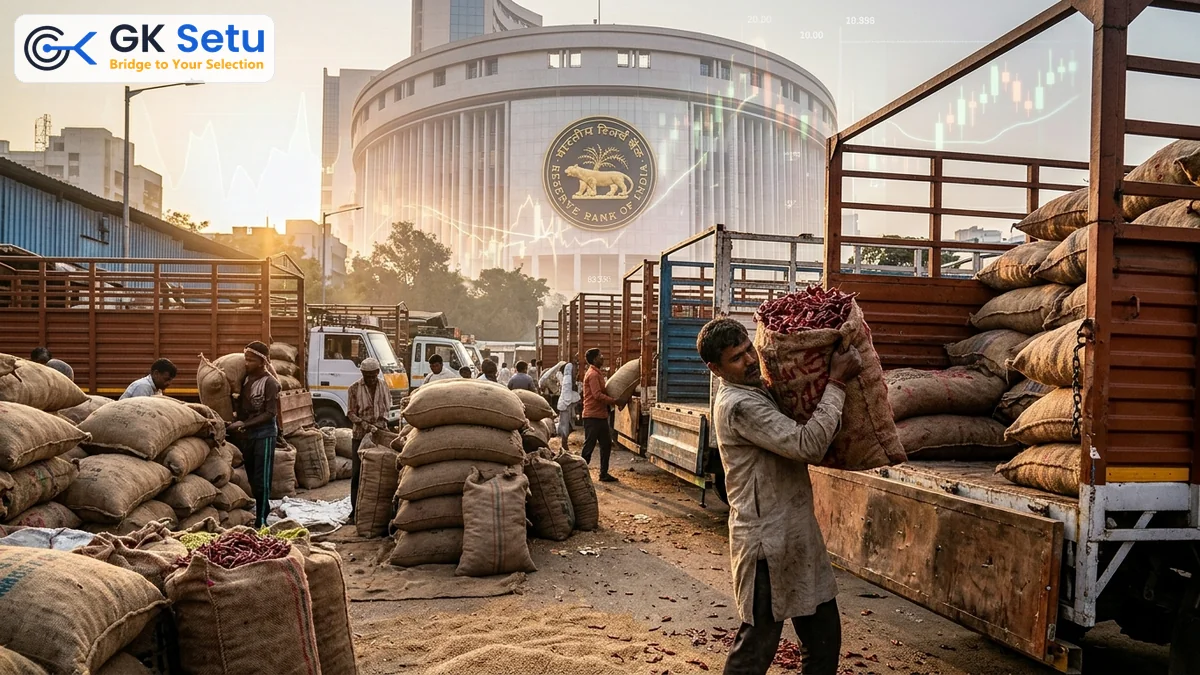
Why RBI Rate Hikes Fail Against Supply Inflation
- Supply-Led Inflation: Price rises caused by a shortage of goods rather than excess consumer demand; critical for civil services exams regarding monetary policy limitations.
- Monetary Policy vs. Fiscal Policy: The division between central bank interest rate controls and government taxation management in stabilizing the macroeconomic environment.
The Catalyst: On November 13, 2026, Chief Economic Advisor V Anantha Nageswaran publicly cautioned that conventional interest rate hikes remain blunt tools when confronting supply-driven inflationary pressures.
The High-Stakes Macro Hook
Imagine running a bustling kitchen where the price of cooking gas and vegetables suddenly doubles overnight because of global supply blockades. Patrons pay more for every meal, not because they order twice as much food, but because basic ingredients grow scarce.
This is the exact dilemma facing India macroeconomic architects. On November 13, 2026, Chief Economic Advisor V Anantha Nageswaran drew a sharp line in the sand, emphasizing that conventional interest rate hikes by the Reserve Bank of India are structurally limited when subduing supply-driven inflationary pressures. Core price dynamics drive India broader inflation breach, testing traditional central banking limits. Yet, amidst geopolitical tensions, India resilience stands out: the central bank projects a robust economic growth rate of 6.9 percent for FY27, reinforced by Moody upgrading growth outlooks near 7 percent.
"Conventional interest rate hikes may remain ineffective in subduing supply-led inflationary pressures, calling for a nuanced interplay between fiscal discipline and monetary intervention." — Chief Economic Advisor V Anantha Nageswaran
Zooming In: What This Means For You
When macro policies shift in North Block and Mint Street, ripple effects travel straight down to local grocery stores, college campuses, and monthly household budgets.
- For Students & Exam Aspirants: Master the distinction between demand-pull inflation, which interest rate hikes cool down, and cost-push or supply-led inflation driven by external geopolitical conflicts. Examiners test understanding of why raising interest rates fails when oil or food supplies bottleneck globally.
- For Working Professionals & Citizens: If planning to buy a home or car, interest rate trends dictate Equated Monthly Installments. When inflation is supply-driven, aggressive rate hikes do not instantly drop vegetable or fuel prices; instead, they risk making loans expensive without easing living costs immediately.
The Big-Picture Horizon
India macroeconomic journey toward the late 2020s is defined by a sophisticated balancing act. As the nation anchors sights on maintaining growth near 7 percent, policymakers recognize that monetary levers alone cannot fix structural supply shocks. By harmonizing fiscal prudence with targeted supply-side interventions, India proves economic maturity, steering steady through international turbulence.