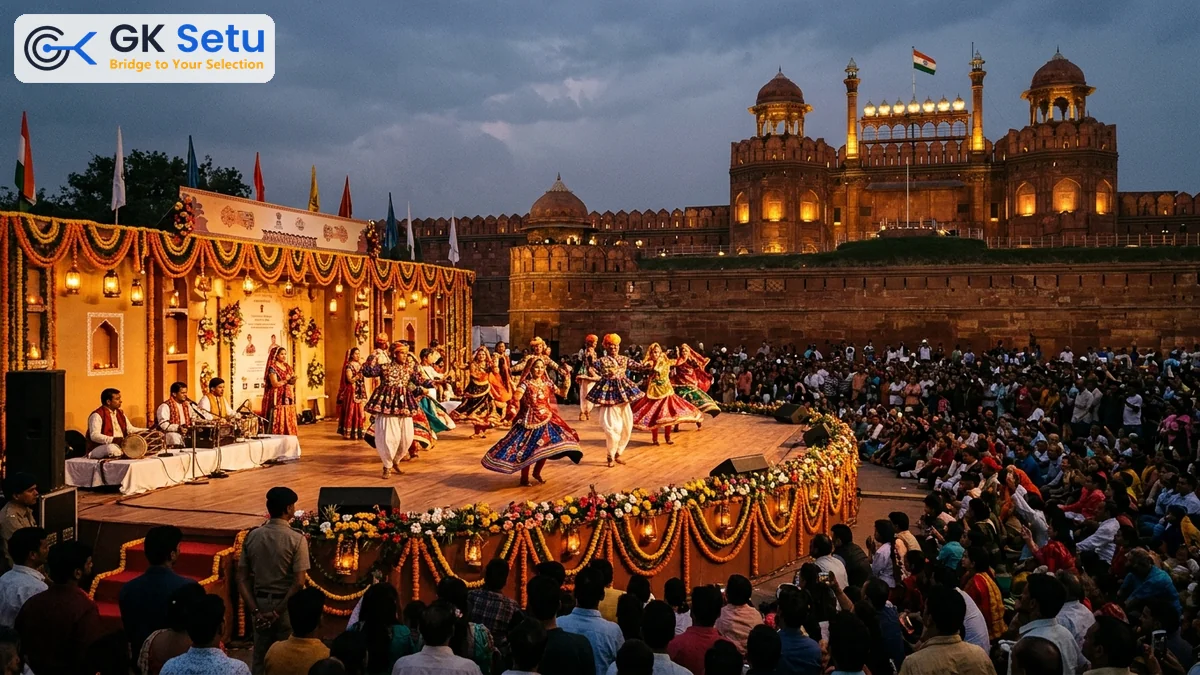
State Power Grid for Folk Arts: Bharat Parv 2026
The "What Happened Yesterday" Catalyst
The Government of Gujarat, in collaboration with the Union Ministry of Culture, organized Bharat Parv 2026 at Ekta Nagar near the Statue of Unity. The mega-event assembled 5,000 traditional, tribal, and classical performing artists from across the country to strengthen national integration while sustaining regional performance traditions.
The Everyday Analogy: The National Power Grid of Culture
Think of India's indigenous performing arts as thousands of off-grid solar generators scattered across rural landscapes. Each produces raw energy. Yet, left isolated without transmission infrastructure, that output remains hyper-local; eventually, without links to broader markets, these traditions risk burning out unnoticed.
State-sponsored cultural assemblies operate like a centralized transmission network. By deploying physical stages, transit logistics, and structured honorariums, state mechanisms plug local folk troupes directly into national awareness. This framework strengthens regional tourism economies while feeding financial resources back into grassroots artistic communities.
The 3-Tier Layered Blueprint
[ Tier 1: Union & State Policy Engine ]
             │ (Mandate: Article 51A(f) & Ek Bharat Shreshtha Bharat)
             ▼
[ Tier 2: Transmission & Mobilization Pipeline ]
             │ (Logistics, Zonal Cultural Centres & Artist Honorariums)
             ▼
[ Tier 3: Grassroots Performance & Heritage Economy ]
             │ (5,000 Artists at Ekta Nagar  Tourism & Livelihood Protection)
Tier 1: Policy Engine and Constitutional Mandate
At the executive level, state planners align cultural showcases with explicit statutory principles. Governed by Article 51A(f) of the Constitution, administrative bodies treat art preservation not as passive entertainment, but as a mandatory civic directive. Crucially, policy frameworks link intangible cultural heritage directly with high-capacity infrastructure developments, such as anchoring mega-festivals alongside the Statue of Unity.
Tier 2: The Transmission Pipeline
Once administrative mandates take shape, institutional channels disburse capital and operational support downward. Regional Zonal Cultural Centres mobilize troupes across diverse districts.
In practice, this transmission pipeline manages three core functions:
- Financial Formalization: Direct honorariums and travel allowances convert unorganized folk practices into recognized micro-economies.
- Curatorial Standardization: Regional forms such as Garba, Bihu, and Chhau undergo staging adaptation for large-scale audience broadcast.
- Logistical Infrastructure: Coordinating transit, security, and housing guarantees stable working conditions for thousands of practitioners.
Tier 3: Grassroots Impact and Heritage Economy
On the ground, institutional assembly yields concrete socio-economic outcomes:
- For Performing Artists
- Structured income streams reduce economic displacement among rural art lineages, preserving fragile traditions through guaranteed state patronage.
- For Citizens and Tourism Markets
- Concentrating diverse performance styles within a single location transforms abstract federal integration concepts into experiential public engagement.
Fast Facts Grid
| Operational Metric | Official Specification / Detail |
|---|---|
| Nodal Agencies | Ministry of Culture (Government of India) & Government of Gujarat |
| Scale & Metric | 5,000 performing artists (Folk, Tribal, and Classical traditions) |
| Venue & Framework | Ekta Nagar, Gujarat | Executed under 'Ek Bharat Shreshtha Bharat' & Article 51A(f) |